
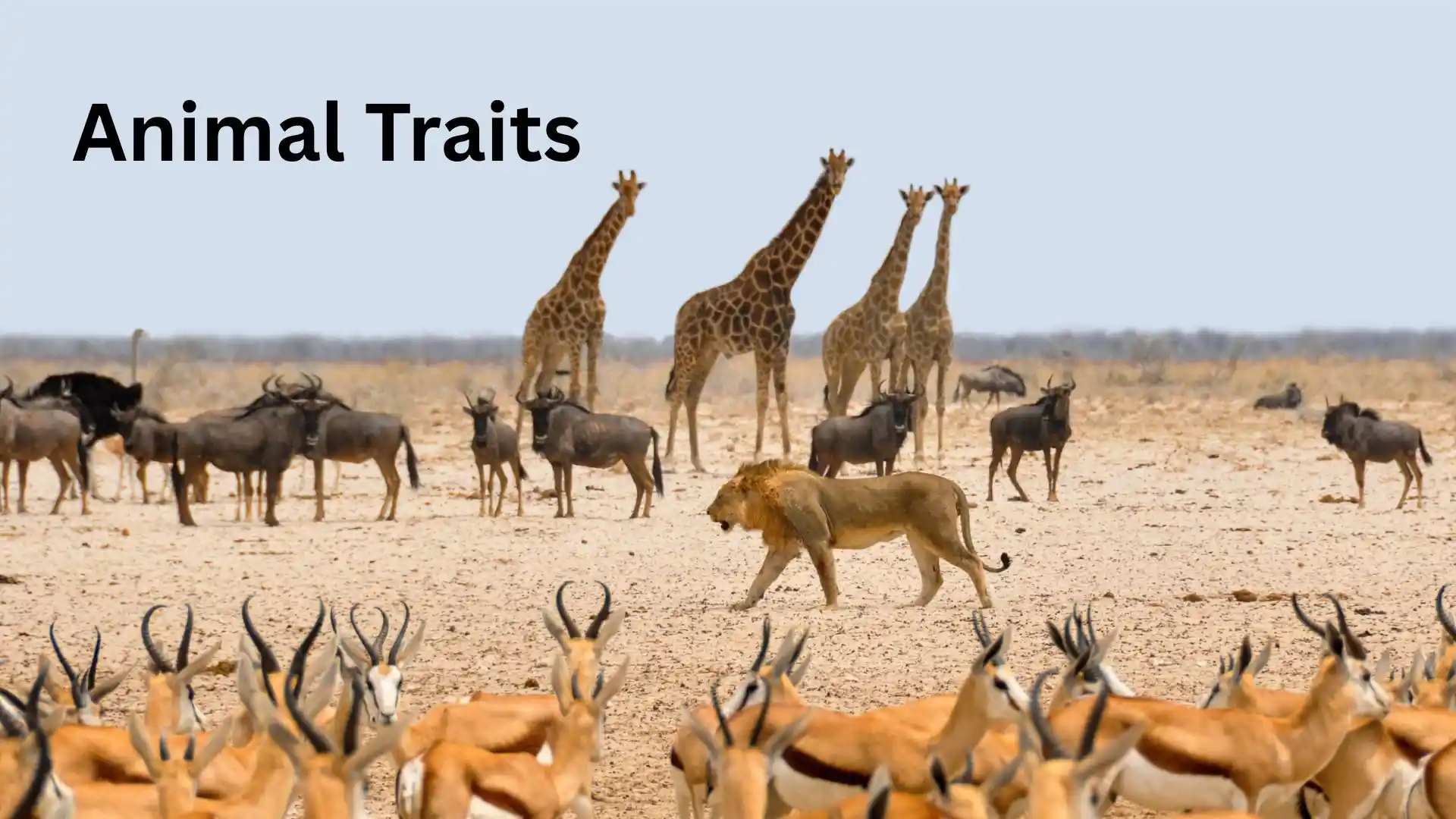
Animal traits are the unique characteristics that define how animals look, behave, survive, and interact with their surroundings. These traits include physical features, behavioral patterns, inherited characteristics, and adaptations that help animals live successfully in different environments.
From a lion’s hunting ability and a bird’s migration skills to a dog’s loyalty and a chameleon’s camouflage, every animal displays special traits that influence its survival. Some traits are inherited through genes, while others develop because of environmental conditions and experiences.
Understanding animal traits helps us learn how species adapt, why animals behave differently, and how biological features support survival. This complete guide explores the meaning, types, examples, importance, and science behind animal traits.
Animal Traits: (Quick Answer)
Animal traits are physical, behavioral, genetic, and adaptive characteristics that describe an animal’s appearance, abilities, and behaviors. These traits are influenced by genetics, evolution, and environmental factors. Animal traits help creatures survive, communicate, reproduce, and adapt to their habitats.
Animal Traits Overview Table
| Trait Category | Explanation | Examples |
| Physical Traits | Visible features of an animal’s body | Fur, feathers, body size, claws |
| Behavioral Traits | Actions and habits of animals | Hunting, migration, communication |
| Genetic Traits | Characteristics passed through DNA | Eye color, coat patterns |
| Adaptive Traits | Features that improve survival | Camouflage, thick fur |
| Social Traits | Behaviors related to groups | Cooperation, bonding |
What Are Animal Traits?
Definition and Meaning of Animal Traits
Animal traits are the characteristics that describe an animal’s physical appearance, biological features, and behaviors. These traits determine how animals move, communicate, find food, protect themselves, and interact with their environment.
A trait can be something visible, such as a tiger’s stripes, or something behavioral, such as a wolf’s ability to cooperate during hunting. Some traits are inherited from parents, while others are influenced by learning and environmental experiences.
Scientists study animal traits to understand genetics, evolution, biodiversity, and animal behavior. Traits explain why different species have developed unique abilities suited to their habitats.
Why Animal Traits Matter in Biology and Everyday Life
Animal traits are important because they show the relationship between animals and their environments. Every species has characteristics that help it survive and reproduce.
Traits help animals:
- Find food and water
- Escape predators
- Communicate with others
- Protect their offspring
- Adapt to environmental changes
- Compete for resources
- Reproduce successfully
Understanding animal traits is useful in many areas, including:
- Wildlife conservation
- Veterinary science
- Animal breeding
- Pet care
- Scientific research
For example, understanding the natural traits of a dog breed helps owners provide suitable training, exercise, and care.
Types of Animal Traits Explained
Physical Traits of Animals
Physical traits are characteristics that can be observed by looking at an animal. These features influence an animal’s appearance, movement, protection, and ability to survive.
Common physical traits include:
- Body size
- Fur, feathers, or scales
- Eye color
- Teeth and claws
- Body structure
- Wings and fins
- Skin patterns
Examples of physical traits:
Cheetah:
A cheetah has long legs, a flexible spine, and a lightweight body that allow it to move quickly while hunting.
Polar Bear:
A polar bear has thick fur and body fat that help maintain warmth in freezing environments.
Birds:
Birds have feathers, wings, and lightweight skeletons that support flight.
Physical traits are often connected to an animal’s habitat and lifestyle.
Behavioral Traits of Animals
Behavioral traits describe how animals act, communicate, and respond to different situations.
These traits include:
- Hunting methods
- Social behaviors
- Migration habits
- Communication systems
- Parenting behaviors
- Defensive actions
Examples:
- Wolves hunt in groups because cooperation increases their success.
- Birds migrate to areas with better food and breeding conditions.
- Bees communicate through movement patterns.
- Dolphins work together to solve problems and protect group members.
Behavioral traits may be instinctive or learned through experience.
Genetic Traits and Inherited Characteristics
Genetic traits are characteristics passed from parents to offspring through DNA. Genes contain biological instructions that influence an animal’s development.
Examples of inherited traits include:
- Fur color
- Feather patterns
- Eye color
- Body size
- Natural abilities
For example, puppies often inherit physical features from their parents, while kittens may receive specific coat patterns through genetic inheritance.
Genetic variation creates differences between animals, even within the same species. These differences help populations adapt over time.
Adaptations and Survival Traits
Adaptations are traits that improve an animal’s ability to survive in a specific environment. These traits develop over generations through evolutionary processes.
Examples of survival adaptations include:
- Camouflage in chameleons
- Thick fur in Arctic animals
- Sharp claws in predators
- Webbed feet in water birds
- Large ears in desert animals
Adaptations help animals:
- Avoid predators
- Find food
- Survive extreme conditions
- Protect themselves
- Increase reproductive success
How Animals Develop Different Traits
Role of Genetics in Animal Traits
Genetics plays a major role in determining animal traits. DNA carries information that influences an animal’s physical features and some natural behaviors.
Animals receive genetic material from their parents, which is why offspring often share similarities with their family members.
Examples:
- A dog may inherit coat color from its parents.
- A bird may inherit feather patterns.
- A horse may inherit body structure and movement abilities.
Genetic diversity is important because it allows species to adjust to changing environments.
Role of Environment and Learning
The environment also affects animal traits. Climate, habitat, food availability, and experiences influence how animals develop.
Examples:
- Young animals learn survival skills by observing adults.
- Pet animals develop behaviors through training.
- Wild animals adjust their actions based on available resources.
Although genetics provides the foundation, environmental conditions can influence how certain traits appear.
Nature vs Nurture in Animal Traits
Animal traits are influenced by both inherited factors and environmental experiences.
| Nature | Nurture |
| Genetic influence | Environmental influence |
| Passed through DNA | Developed through experiences |
| Example: fur color | Example: learned behavior |
A dog may naturally have protective instincts, but training and social experiences influence how those instincts are expressed.
Common Behavioral Traits Found in Animals
Social Traits and Communication
Many animals develop social traits that allow them to cooperate and live together.
Examples include:
- Elephants protecting family groups
- Wolves hunting as teams
- Bees organizing colonies
- Dolphins communicating with sounds
Animal communication may involve:
- Vocal sounds
- Body language
- Scents
- Visual signals
Social traits improve survival because animals can work together to find food, defend themselves, and care for young.
Hunting, Feeding, and Survival Behaviors
Animals develop specialized traits for finding and consuming food.
Examples:
- Eagles use sharp eyesight to locate prey.
- Lions cooperate during hunting.
- Spiders create webs to capture insects.
- Woodpeckers use strong beaks to search for food.
Feeding behaviors are usually connected with physical traits that make survival easier.
Protective and Defensive Behaviors
Animals use defensive traits to protect themselves from threats.
Examples:
- Turtles hide inside protective shells.
- Porcupines use sharp quills.
- Skunks release strong odors.
- Octopuses change color to hide.
These behaviors increase an animal’s chances of avoiding danger.
Positive and Interesting Animal Traits
Intelligence and Problem-Solving Abilities
Some animals display impressive intelligence and the ability to solve problems. These traits help animals respond to challenges, find resources, and adjust to changing environments.
Examples of intelligent animal traits include:
- Using tools to access food
- Learning new behaviors
- Remembering locations
- Solving environmental challenges
- Communicating with other individuals
Examples:
Crows:
Crows are known for their ability to use simple tools and solve problems to obtain food.
Dolphins:
Dolphins demonstrate complex communication and cooperative behaviors within groups.
Chimpanzees:
Chimpanzees can learn behaviors by observing others and using objects in their environment.
Octopuses:
Octopuses show advanced problem-solving abilities and can adapt quickly to new situations.
Intelligence is an important trait because it allows animals to survive when instinct alone is not enough.
Loyalty, Cooperation, and Social Bonding
Many animals develop strong social traits that help them create relationships and cooperate with others.
Examples include:
- Dogs forming close bonds with humans
- Elephants protecting family members
- Wolves working together in packs
- Penguins sharing parenting responsibilities
Social bonding helps animals:
- Protect group members
- Raise offspring successfully
- Find food more efficiently
- Defend territory
These traits show that survival is not always based on individual strength. Cooperation can be equally important.
Strength, Speed, and Adaptability
Physical abilities often determine how animals survive in their environments.
Examples:
Cheetah:
Uses speed to catch prey.
Elephant:
Uses strength for protection and survival.
Kangaroo:
Uses powerful legs for movement and escaping threats.
Mountain Goat:
Uses strong legs and balance to survive in rocky habitats.
Adaptability is one of the most valuable animal traits because environments constantly change.
Animal Traits Across Different Species
Mammal Traits
Mammals have several common traits that separate them from other animal groups.
Common mammal traits include:
- Hair or fur
- Warm-blooded bodies
- Milk production for young
- Advanced nervous systems
- Complex social behaviors
Examples of mammals include:
- Dogs
- Cats
- Elephants
- Lions
- Whales
- Horses
Mammals display a wide range of physical and behavioral traits depending on their habitats.
Bird Traits
Birds have specialized traits that allow them to survive in different environments.
Common bird traits include:
- Feathers
- Wings
- Lightweight bones
- Beaks
- Egg-laying reproduction
Examples:
Eagles:
Have excellent eyesight for hunting.
Penguins:
Have adapted wings and body structures for swimming.
Migratory birds:
Have navigation abilities that help them travel long distances.
Bird traits demonstrate how physical structures support survival.
Reptile Traits
Reptiles have unique characteristics that help them survive in various climates.
Common reptile traits include:
- Scaly skin
- Cold-blooded metabolism
- Strong protective coverings
- Ability to survive with limited resources
Examples:
- Snakes
- Lizards
- Crocodiles
- Turtles
Many reptiles have adaptations that help them conserve energy and survive harsh environments.
Fish Traits
Fish have specialized traits designed for aquatic life.
Common fish traits include:
- Gills for breathing underwater
- Fins for movement
- Scales for protection
- Streamlined bodies
Examples:
Sharks:
Have powerful senses for locating prey.
Clownfish:
Have behaviors that help them live among sea anemones.
Salmon:
Have migration abilities that allow them to return to breeding areas.
Insect Traits
Insects have some of the most diverse traits in the animal kingdom.
Common insect traits include:
- Exoskeleton
- Six legs
- Antennae
- Specialized body structures
Examples:
Butterflies:
Have colorful wings used for communication and protection.
Bees:
Have social traits and organized colony behavior.
Ants:
Display cooperation and complex group systems.
Animal Traits vs Animal Characteristics
| Animal Traits | Animal Characteristics |
| Specific features or behaviors | General descriptions of animals |
| Often studied scientifically | Used for basic identification |
| Can be inherited or developed | Describe overall appearance or behavior |
| Example: striped fur | Example: wild appearance |
Animal traits focus on individual qualities, while characteristics describe broader descriptions.
For example:
- “A tiger has stripes” describes a trait.
- “A tiger is a large wild cat” describes a characteristic.
Animal Traits vs Personality Traits
How Animal Traits Differ From Human Personality Traits
Animal traits and human personality traits are sometimes compared, but they describe different concepts.
Animal traits usually refer to:
- Biological features
- Survival abilities
- Natural behaviors
- Physical adaptations
Human personality traits usually describe:
- Emotional patterns
- Social behaviors
- Individual preferences
- Character qualities
Examples of human personality traits:
- Honesty
- Confidence
- Patience
- Creativity
Examples of animal traits:
- Hunting ability
- Camouflage
- Migration
- Communication
Why People Compare Animal and Human Behaviors
Humans often describe animals using personality words because some behaviors appear similar to human actions.
Examples:
- Dogs are called loyal because they form strong social connections.
- Elephants are described as caring because they protect group members.
- Primates show behaviors that appear socially complex.
However, animal behavior should always be understood through biology rather than human emotions alone.
Real Life Examples of Animal Traits
Examples From Domestic Animals
Domestic animals display many traits that affect how humans interact with them.
Dogs:
- Loyalty
- Social bonding
- Protective instincts
- Learning ability
Cats:
- Hunting instincts
- Independence
- Agility
- Curiosity
Horses:
- Strength
- Communication through body language
- Social awareness
These traits influence training, care, and animal-human relationships.
Examples From Wild Animals
Wild animals demonstrate specialized traits for survival.
Examples:
Lion:
- Group hunting behavior
- Strong physical ability
- Territorial instincts
Polar Bear:
- Cold-weather adaptation
- Strong swimming ability
- Excellent sense of smell
Butterfly:
- Color patterns
- Flight ability
- Life-cycle adaptations
Frog:
- Camouflage
- Jumping ability
- Environmental sensitivity
Examples From Scientific Studies
Scientists study animal traits to understand:
- Evolution
- Genetics
- Ecosystem relationships
- Species conservation
Research on animal traits helps experts protect endangered species and understand how animals respond to environmental changes.
Common Misconceptions About Animal Traits
Myth: All Animals of the Same Species Have Identical Traits
Fact:
Animals of the same species can have different traits because of genetic variation and environmental influences.
For example, two dogs of the same breed may have different personalities, sizes, or coat patterns.
Myth: Animal Behavior Is Only Controlled by Instinct
Fact:
Many animals learn behaviors through observation, practice, and experience.
Young animals often learn survival skills by watching adults.
Myth: Traits Cannot Change
Fact:
Individual inherited traits remain mostly stable, but species can develop new adaptations over many generations through evolution.
Myth: Bigger Animals Always Have Better Traits
Fact:
Successful survival depends on having suitable traits, not simply being larger or stronger.
A small insect may survive because of camouflage, speed, or reproduction ability.
Related Animal Trait Concepts
Animal Behavior
Animal behavior focuses on how animals act, communicate, and respond to their environment.
It includes:
- Feeding behaviors
- Social interactions
- Reproduction behaviors
- Defensive actions
Animal Adaptation
Animal adaptation explains how traits help species survive in specific environments.
Examples:
- Desert animals conserving water
- Arctic animals maintaining body heat
- Aquatic animals moving efficiently underwater
Evolution and Natural Selection
Evolution explains how helpful traits become more common in populations over generations.
Natural selection occurs when certain traits provide survival advantages.
Genetics and Heredity
Genetics explains how traits are passed between generations through DNA.
Heredity helps explain why offspring often resemble their parents.
Frequently Asked Questions About Animal Traits
What Are the Main Types of Animal Traits?
The main types of animal traits are physical traits, behavioral traits, genetic traits, adaptive traits, and social traits.
Are Animal Traits Passed From Parents?
Many animal traits are inherited through DNA from parents, while others develop through environmental experiences.
Why Do Animals Have Different Traits?
Animals have different traits because of genetic variation, environmental conditions, and evolutionary changes.
Can Animals Learn New Traits?
Animals can learn new behaviors, but inherited physical traits usually cannot change during an individual animal’s lifetime.
What Is the Difference Between Physical and Behavioral Traits?
Physical traits describe an animal’s body features, while behavioral traits describe actions and responses.
How Do Animal Traits Help Survival?
Animal traits help creatures find food, avoid danger, communicate, reproduce, and adapt to their surroundings.
Key Takeaways About Animal Traits
- Animal traits describe physical, behavioral, and genetic characteristics.
- Traits influence how animals survive and interact with their environments.
- Genetics and environmental factors both affect animal development.
- Adaptations are survival traits that help species handle challenges.
- Different species have unique traits based on their habitats.
- Understanding animal traits helps improve wildlife conservation and animal care.
Conclusion
Animal traits explain the incredible diversity found throughout the animal kingdom. Every species has developed unique characteristics that allow it to survive, reproduce, and interact with its environment.
From physical adaptations like camouflage and strong claws to behavioral traits like cooperation and communication, animal traits reveal how life responds to challenges. Learning about these characteristics helps humans better understand animals, protect wildlife, and appreciate the complexity of nature.

I’m Alistair Pembroke, a British author interested in the enduring patterns that define human character. My work explores personality traits, behavioural tendencies, emotional qualities, and social characteristics. I translate complex ideas into clear insights, helping readers examine how traits develop, interact, and influence the ways individuals perceive themselves and others.
Books:
- The Psychology of Human Traits
- Patterns of Character and Personality
 Sebastian Langford
 Fairchild Edmund Fairchild